REMAL - Reducing Marine Litter in the Mediterranean through Waste Wise Cities Lebanon
Over the years, Lebanon’s solid waste sector has been among the most chronically challenged public service sectors, characterised by a lack of transparency, inefficiencies in waste collection, treatment, and disposal, and poor financial sustainability.
While the Ministry of Environment (MoE) holds the primary mandate for Integrated Solid Waste Management (ISWM) at the central level, and local authorities at the regional level, the sector has long suffered from fragmented responsibilities and weak coordination between public and private actors. This has hindered both strategic planning and the implementation of essential reforms, preventing the adoption of efficient, circular-economy–aligned waste management systems. In 2018, Law 80 on ISWM was passed, introducing the guiding legal framework for sector reform. However, many of its related implementation decrees and decisions remain undrafted, unendorsed, or unenforced.
The 2019 financial and economic crisis, accompanied by sharp currency devaluation and a severe shortage of public funds, has further crippled the sector. Service delivery across the waste management chain has drastically declined, raising serious concerns for public health, food safety, environmental sustainability, and broader socio-economic stability.
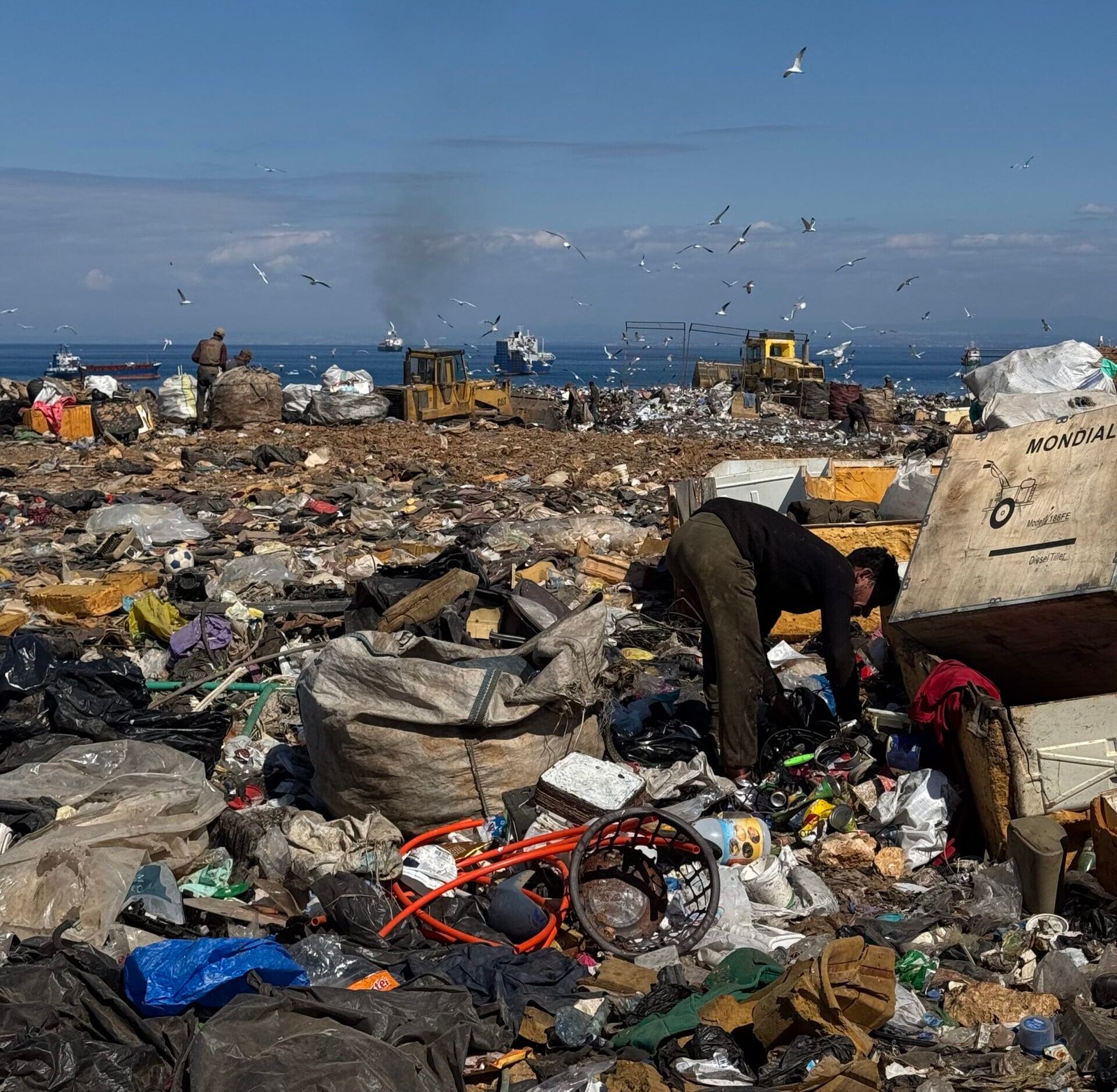
Waste pickers at Tripoli landfill site, Lebanon. Image: UN-Habitat
Currently, central government support can barely sustain basic waste disposal services in major urban areas, risking imminent environmental and health-related hazards. Meanwhile, most municipalities are allocating over 75 per cent of their budgets—or incurring significant deficits—to waste collection and disposal, often in inadequate and unsafe ways. This financial burden undermines their role in local development and limits their ability to deliver other essential public services.
In response to these pressing challenges, the Reducing Marine Litter in the Mediterranean through Waste Wise Cities Lebanon (REMAL) project (2023–2025)—funded by the Federal Ministry for the Environment, Climate Action, Nature Conservation and Nuclear Safety (BMUKN) with approximately EUR 4.5 million—aims to reduce marine litter in Lebanon by supporting coastal Unions of Municipalities and national institutions in implementing Law 80/2018. The project adopts UN-Habitat’s Waste Wise Cities Tool (WaCT) and focuses on developing service zone-level Local Operational Master Plans, implementing pilot projects, raising public awareness, and proposing policy recommendations—particularly in relation to plastic waste management. Over the long term, the project seeks to improve resource efficiency and municipal solid waste management in Lebanon’s coastal areas.
Expected outcomes
Reduce overall plastic waste generation by 5% (around 10 t/day) through awareness-raising activities.
Reduce openly dumped plastic waste by approximately 5 t/day that could otherwise end up in the Mediterranean.
Ensure orderly waste collection and registration, and, where possible, high-quality material recycling.
Build relevant capacities in partner countries.
Orientation: SDGs
The REMAL project will contribute to the achievement of the UN Sustainable Development Goals (SDGs) by preventing marine litter through improved access to waste collection, reduced uncollected and unmanaged waste, enhanced resource recovery, job creation, and the promotion of circular economy (business) models.