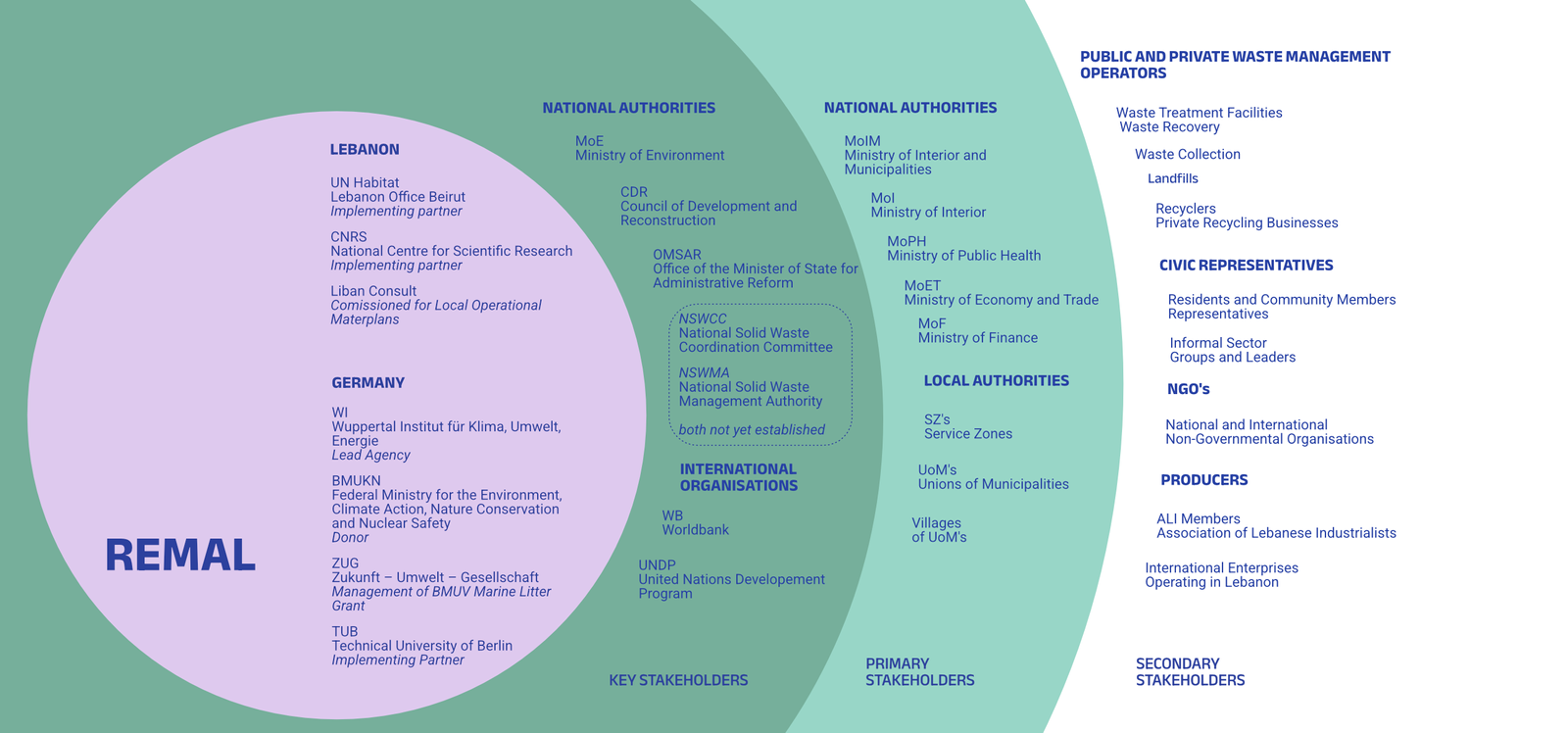
REMAL is jointly implemented by the Wuppertal Institute for Climate, Environment and Energy, UN-Habitat Lebanon, and the Technical University of Berlin, in close coordination with the Lebanese Ministry of Environment (MoE), the Ministry of Interior and Municipalities (MoIM), and various Unions of Municipalities and Municipalities. Key stakeholders include national policymakers, informal waste workers, private (formal and informal) waste management companies, NGOs, and community members.
UN-Habitat Lebanon
UN-Habitat works in over 90 countries, supporting people in cities and human settlements for a better urban future. Working with governments and local partners, its high-impact projects combine world-class expertise with local knowledge to deliver timely, targeted solutions. The 2030 Agenda for Sustainable Development includes a dedicated goal on cities, SDG 11 – to make cities inclusive, safe, resilient, and sustainable.
The Wuppertal Institute is a leading think tank on sustainable transformation. Our vision is a sustainable world for everyone. We define this as a just transformation towards a future in which global warming is reduced to a tolerable level and Earth’s resources are managed so that everyone can enjoy a good life within planetary boundaries. Together with our stakeholders, we shape transformation processes by developing science-based solutions to ecological, social, political, and economic challenges – from practical measures for urban communities and companies to fresh impetus for international climate negotiations.
The Habitat Unit at TU Berlin (International Urbanism and Design) is a globally networked research and teaching platform that engages with global urbanisation and transformation processes through the development of new conceptual approaches, expertise, and application-oriented tools. The Habitat Unit advocates for socially inclusive and participatory urban policies, urban management models, and planning processes.
Stakeholder mapping is a key tool for identifying and visually organising individuals, groups, and institutions according to their level of influence and interest in the planning process. As part of the REMAL project, a stakeholder mapping exercise was conducted to support the effective planning and implementation of sustainable solid waste management (SWM) in Lebanon’s coastal areas. This mapping contributes to a broader Stakeholder Engagement Plan developed in line with the Waste Wise Cities Tool (WaCT) guidelines.